
Best Books for Relationship Advice and Which Ones Have Evidence Behind Them
As an Amazon Associate I earn from qualifying purchases. Some links may earn us a commission at no extra cost to you.
This shelf holds two kinds of book that look identical from a listing page. Some are written out of decades of observational research on real couples, where the claims have been measured and can be wrong. Others are one person’s framework, sold confidently, tested by nobody. Both sell well and both sound equally sure of themselves, and the more popular a framework becomes the less anybody asks whether it holds up. So I score these on the strength of the evidence behind the advice, and the best selling book on this page scores lowest on that measure, which is worth knowing before you buy it rather than after.
Top picks
The Seven Principles for Making Marriage Work — Best overall


Why it wins: John Gottman spent years watching couples interact in an observation lab and tracking which ones stayed together, and this is the readable version of what that work found. The specifics are what make it useful: the four communication patterns that predict separation, the ratio of positive to negative exchanges in stable couples, the finding that most disagreements are never resolved and healthy couples manage them instead.
Pros
- Grounded in longitudinal observation rather than one clinician’s impressions
- Concrete and testable claims instead of general encouragement
- Exercises at the end of each chapter that a couple can do together
- Widely used by therapists, so a counsellor will know it
Cons
- Written around married heterosexual couples, and the language shows its age
- The research base skews toward American couples who volunteered for studies
- Dense in places for a book you are meant to read together
Social proof: See rating and reviews on Amazon.
Trade-offs and who should skip: The one to buy if you buy one. Skip it if you want something quick and warm. Skip it if a clinical tone puts you off.
Scores: Performance 5/5 | Evidence base 5/5 | Ease of use 4/5 | Value 5/5
Attached by Amir Levine and Rachel Heller — Best for understanding your patterns

- Attached: The New Science of Adult Attachment and How It Can Help You Find-and Keep-Love
Why it wins: Attachment research goes back to the middle of the last century and is among the better supported ideas in psychology, and this book brings it to adult romantic relationships in plain language. It explains why one person needs reassurance and another needs space, and why those two keep finding each other.
Pros
- Built on a large and long-standing research literature
- Explains a pattern most people recognise immediately in themselves
- Practical about what anxious and avoidant partners can each do differently
- More than twenty thousand ratings at a strong average
Cons
- Sorting people into three types is a simplification of a spectrum
- Easy to turn into a label and use it to excuse behaviour rather than change it
- Skews toward dating rather than long-established couples
Social proof: See rating and reviews on Amazon.
Trade-offs and who should skip: Excellent explanation, and a framework people over-apply. Skip it if you would use the category as an identity. Skip it if your issue is a specific conflict rather than a pattern.
Scores: Performance 5/5 | Evidence base 4/5 | Ease of use 5/5 | Value 5/5
Fight Right by John and Julie Gottman — Best on conflict specifically
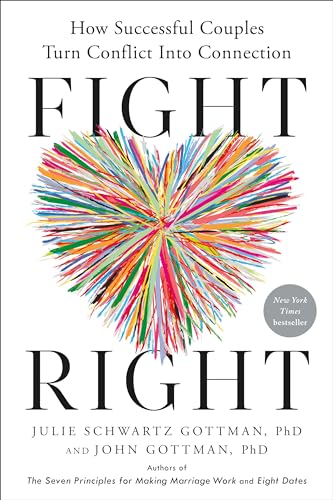
Why it wins: A recent book from the same research programme, narrowed to the one subject most couples actually want help with. It treats arguing as a skill with identifiable failure modes rather than as a sign that something is wrong, and it is more current than the older title in both its examples and the couples it includes.
Pros
- Focused on the single problem most readers came for
- More recent research and a broader range of couples than the 1999 book
- Names specific conflict styles instead of prescribing one correct way to argue
Cons
- Overlaps a good deal with the earlier Gottman book
- Smaller review base than the classics here
- Hardcover, so it costs more than the paperbacks on this page
- Narrow by design, and it will not cover the rest of a relationship
Social proof: See rating and reviews on Amazon.
Trade-offs and who should skip: The specialist volume. Skip it if you already own the Seven Principles and want new material. Skip it if conflict is not your problem.
Scores: Performance 4/5 | Evidence base 5/5 | Ease of use 4/5 | Value 4/5
Love More, Fight Less — Best for actually doing something

Why it wins: A workbook rather than a book, which addresses the real failure mode of this whole category: one partner reads something, feels understood, and nothing changes. Exercises, scripts and prompts that two people fill in together turn reading into a conversation, and a conversation is the only mechanism by which any of this works.
Pros
- Format requires both people to participate
- Scripts for opening difficult conversations
- Written by a practising couples counsellor
- Works alongside the theory books rather than competing with them
Cons
- Lowest average rating of the five here
- Useless if your partner will not sit down with it
- Exercises feel awkward and school-like to some readers
- Consumable, so it is a single-couple purchase
Social proof: See rating and reviews on Amazon.
Trade-offs and who should skip: The one that asks something of you. Skip it if you are reading on your own. Skip it if guided exercises make you cringe.
Scores: Performance 4/5 | Evidence base 3/5 | Ease of use 4/5 | Value 4/5
The 5 Love Languages — Best selling, weakest evidence
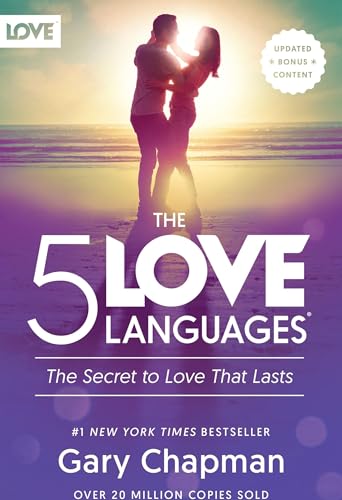
Why it wins: It is here because it dominates the category and because that popularity is not the same as being right. More than ninety thousand ratings and tens of thousands of copies sold monthly make it the most read relationship book of the last thirty years. Researchers who have tested the central claim, that couples do better when partners match love languages, have not found consistent support for it, and the five categories do not hold up as distinct types when measured.
Pros
- Enormously popular, so almost any partner will already know the concept
- Gives couples a shared vocabulary for talking about feeling neglected
- Short, warm and easy to finish
- The underlying suggestion to notice what your partner values is sound
Cons
- The matching claim at the heart of it is not well supported by research
- The five categories were derived from one counsellor’s notes rather than from data
- Encourages treating a preference as a fixed trait
- Written from an explicitly Christian marriage perspective, which is not signposted prominently
Social proof: See rating and reviews on Amazon.
Trade-offs and who should skip: A useful conversation starter sold as a discovered law. Skip it if you want findings you can rely on. Skip it if the religious framing does not suit you.
Scores: Performance 3/5 | Evidence base 1/5 | Ease of use 5/5 | Value 4/5
Quick compare
- Best overall: Seven Principles, dated language
- Best on your own patterns: Attached, easy to over-apply
- Best on arguing: Fight Right, overlaps the Gottman classic
- Best for doing rather than reading: Love More Fight Less, needs both of you
- Best selling: 5 Love Languages, the core claim has not held up
Two things worth saying plainly. A book is not couples therapy, and if you are both reading and nothing shifts over a few months, that is information rather than failure: a counsellor watching you talk can see things neither of you can, and going early is far more effective than going as a last resort. And none of this applies to a relationship involving coercion, intimidation or violence. Communication advice assumes two people who are both safe and both trying, and where that is not the case, better listening is not the answer and can make things more dangerous. That situation calls for a domestic abuse helpline or a specialist service rather than a bookshop.
As an Amazon Associate, I earn from qualifying purchases.